
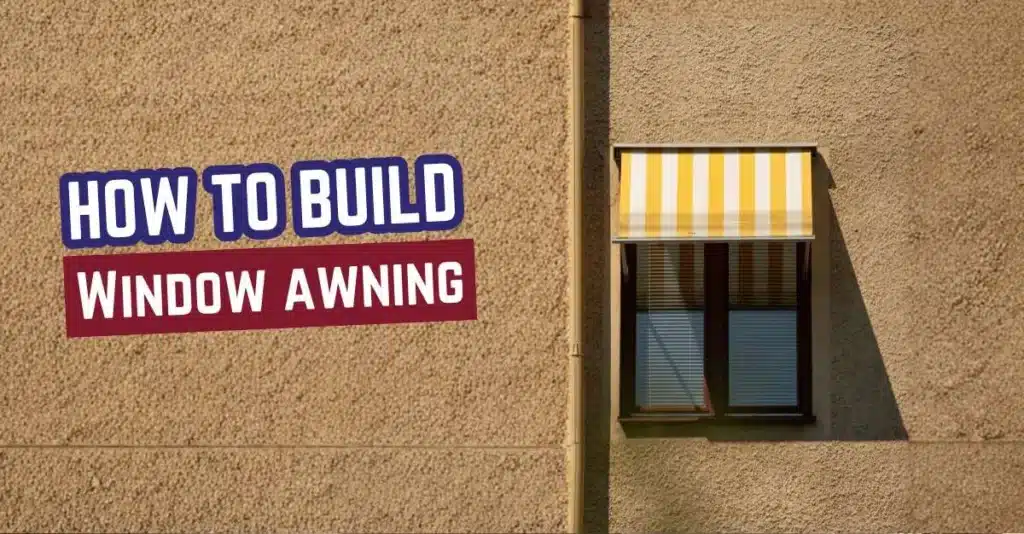
Building a DIY window awning requires very few tools and materials, and a little bit of patience. If you are already handy with making things on your own, this is a big plus. Let us walk you through how you can make your eye-soothing window awning in some simple steps!
Tools & Materials You’ll Need For A DIY Window Awning

- Painter’s drop cloth
- 1×4 wood strips (for the frame)
- Miter saw
- Table Saw
- Power drill
- Ladder
- Screws and anchors (for mounting)
- Staple gun & staples
- Scissors or rotary cutter
- Velcro
Supplies You’ll Need For A DIY Window Awning

- Safety glasses
- Work gloves
- Wood glue
- Measuring tape
- Non-permanent adhesive spray
- Stencil
- Decor Stamps
- Velcro
How To Build A Window Awning: Step-By-Step
We bet you have gathered all the tools and supplies needed for a DIY window awning. Let’s begin with the steps, one by one!
- Step 1: Build The Awning Frame
- Step 2: Measure And Cut Fabric For Your DIY Window Awning
- Step 3: Sew Fabric Pieces Together
- Step 4: Decorate DIY Window Awning With Paint And Stencils
- Step 5: Attach DIY Window Awning To Frame
Now, let’s see how you can start on your project, with details!
Step 1: Build The Awning Frame

The whole task of building an awning over a window becomes easier when you build the frame first. You need to build two pieces, a top and a bottom piece of the frame. Therefore, the job is to use wood strips to make these pieces.
Once your pieces are built, you can attach your awning frames to the wall easily with metal brackets and screws. We begin with the central part of your window awning: the frame. Think of this as the skeleton that will support your shelter. You’ll need two frames: one on the top and one on the bottom.
- Top frame: For the top frame, use a wooden 1×4. It will be 0.75” thick and 3.25” wide. Measure your window’s full width from trim to trim, then add 2 inches. Cut your frame that length and fix it to the wall 4 inches above your window. You will need to use metal brackets to hold it in place.
- Lower frame: To create the lower frame, make it the same length as the top frame. Cut two shorter side pieces about 9¼ inches if you want a 10-inch projection, and join everything with glue and pocket-hole screws. Attach the lower frame one inch above the shutter casing. You’ve just built the foundation of your DIY window awning!
Step 2: Measure And Cut Fabric For Your DIY Window Awning

Here comes the fun part, fabric preparation! You need to make three fabric pieces: one for the center and two for the sides. For the center panel, use the same measurements as the top frame length and then add your desired drop length (for us, it was 25½”), and remember to add ½ inch on all sides for seams.
For the side panels, it’s a little different. They are tiny triangles that give your awning its shape. Measure 4.25” across the top (that’s the width of your 1×4) and 25.5” down for length.
Then, at the bottom, measure 11” across to match the projection. Draw a diagonal line connecting the top and bottom marks and cut along that line. Do the same for the other side.
Don’t stress about it not being flawless – fabric allows for little missteps. Remember, we’re aiming for that adorable cottagecore vibe!
Step 3: Sew Fabric Pieces Together

It’s time to bring your panels to life! Start by laying the center piece flat, right side up. Place the side panels along the edges, right sides together, and the angled edges aligned.
Pin it down, and remember to leave a half-inch seam allowance. Then, stitch along the pinned edges, taking care to follow the seam allowance.
Now, unfold the panels and admire the shape of your awning! Check the hang against the frame. If it looks slightly off, don’t worry. You can always adjust it by trimming or re-sewing little bits.
The sewing doesn’t need to be perfect. The important thing is that your awning hangs evenly to frame your window beautifully. You’ll be thrilled to see how three simple stitched pieces transform into a lovely piece of awning!
Step 4: Decorate DIY Window Awning With Paint And Stencils

This is the time to add personality to your awning if you used a plain drop cloth! You can differentiate it with striped patterns, floral borders, or even vintage lettering.
When you have the fabric laid flat, you will be using a can of spray adhesive on the back of the stencil to keep it from moving.
Using a stencil brush, dip it into the chalk paint and tap up and down to paint around the edges instead of side to side to keep the lines crisp. When you pull the stencil off, admire the pattern you just created and repeat the process on the same fabric.
Use decorative stamps for a unique design element. Paint a pattern on the stamp, press it on the fabric, and lift it straight off to uncover the stamp pattern!
This is the step that adds charm to your awning. It’s where you customize it to your style, whether you prefer the gentle vibes of a cottage, modern patterns, or something fun for a children’s room.
Step 5: Attach DIY Window Awning To Frame

You will need some Velcro strips for the final assembly, one to the top wooden frame, the other to the top edge of your fabric. For additional support, you can staple the Velcro to the wood. Press the fabric down to hang. It’s that simple!
Step back and enjoy the view. You can now admire your DIY window awning, giving your window a warm European style. It also keeps the interior cool and shaded as you follow the guide on how to build a wood awning, with a little patience.
You can easily remove it to wash, repaint, or swap the fabric for other seasons. It is an easy weekend project that adds a lot of charm to the face of your home!
Why Build Your Own Window Awning?
Now that we are done sharing the detailed process of how to build a window awning frame and your DIY window awning, let’s look at the reasons why you should take this project!
- Budget-friendly: Building your DIY awning means you can get extra benefits like sun protection and weather protection at a lower expense.
- Room for Customization: Building your DIY awning gives you the freedom to decorate it as you want. So, you can increase your home’s aesthetics with your unique taste.
- Energy Savings: Awnings can block up to 65% of solar heat gain in the summer. So, it reduces your air conditioning costs, which can be a blessing to your pocket.
- Satisfaction: Completing a DIY project like this can be rewarding while you can use your creativity.
Common Mistakes To Avoid While Building Your DIY Window Awning

- Inaccurate Measurements
- Incorrect Mounting
- Failing To Ensure Adequate Support
- Overlooking Drainage Needs
- Use of Improper Tools and Equipment
- Ignoring Manufacturer’s Instructions
- Choosing Not To Seek Professional Help
Inaccurate Measurements
One wrong inch can throw your awning’s balance off! That’s why you always measure twice before cutting anything. Measure your window width from trim to trim, then add two extra inches. This ensures the awning extends a little beyond both sides.
For the drop length, check from the top frame to the lower frame, and add half an inch for the seams. These errors may seem minor, but they will cause saggy fabric or crooked fittings. It would help if you always keep a notepad for each measurement.
Incorrect Mounting
When you’re in a hurry, it’s easy to make mistakes when mounting. Your top frame should sit four inches above the window frame and be held tight with metal brackets. If it’s mounted too low, the awning will block sunlight; too high, it won’t shade the window properly.
Before you tighten the screws, make sure to use a level tool to check straightness. For a neat line, the bottom frame should be placed exactly one inch above the shutter casing.
Failing To Ensure Adequate Support
Even the prettiest awning won’t last if it’s weakly supported. Before attaching anything, check your wall material: brick, wood, or concrete. For your wall surface, use the right anchors and heavy-duty screws.
If your frame feels wobbly, add extra brackets or corner braces for safety. Each side piece should be firmly connected to the center bar using pocket-hole screws and glue. A well-supported awning will remain sturdy in the wind or rain.
Not Considering Drainage Needs
When building an awning, make sure you consider how water will drain away. If you do not create a sloped awning, water will pool, causing the fabric to sag.
If you give the awning a downward slope of about an inch drop every foot, water will drain away instead of pooling, keeping the awning dry and clean.
Also, remember not to make the design completely flat, as it will be more susceptible to water pooling. A water-resistant fabric spray works well to help the fabric drain water. A sloped awning will make it more durable.
Not Using the Right Tools
Your tools determine how smoothly your project will go. Using dull blades will rip fabric and create splinters, while dull tools in general will create rough edges. If you organize your tools before starting, you will save yourself a lot of frustration.
Make sure not to use mismatched tools, as they cause uneven cuts. Everything should be laid out in advance to avoid stressful and disorganized work.
Overlooking Guide Instructions
If you have kits or materials that come with instructions, you must read them! Newcomers tend to skip this, thinking it is all common sense. However, every product has its individual quirks: different screw sizes, fabric strength, adhesive drying times, and different types of paint.
While ignoring instructions, one risks exposing weak joints or joints that can turn brittle. Manuals are meant to be read closely and followed line by line. They are quiet helpers, saving you from hidden mistakes.
There are also many care instructions that will improve the neatness and longevity of your fabric awning.
Not Asking for Help
At times, and for some tasks, asking for help can save time and the frustration of having to fix your mistakes. There is nothing wrong with calling an expert like Awning San Diego or asking a friend with experience, especially for sewing big fabric panels or for instructions on how to mount on a brick.
These people can help you visualize angles, fabric tension, and the wall anchors you will be using. Most hardware stores will offer this instruction for free.
Final Thoughts
We have reached the end of our guide on how to build a window awning. If you have gathered everything, it’s time to start on the project. However, if you are not handy with building something on your own, we suggest getting our services at Awnings San Diego. Doing everything alone may feel brave, but it is best to think your DIY project through before it becomes unsafe.
Frequently Asked Questions (FAQs)
What materials are best for a DIY window awning?
For the frame, you can choose Aluminum as it is lightweight and rust-resistant. Acrylic fabric works great for UV protection and long life. For budget projects, PVC pipe or wood can be used.
How do I measure correctly before building an awning?
Start by measuring the width of your window and add 4-6 inches on each side for coverage. Measure the projection based on the sunlight angle, usually one-third of the window height. Finally, note the slope height so rain runs off smoothly without pooling.
What tools and fasteners do I need for installation?
You’ll need a measuring tape, drill, level, wrench, screwdriver, and hacksaw. Use screws, wall anchors, L-brackets, and bolts for secure mounting.
How do I attach the awning to the wall safely?
Mark and drill holes into wall studs or solid masonry for strong support. Insert anchors or expansion bolts. Then, mount the brackets using a level to ensure precise placement. Finally, attach the awning frame and tighten all bolts.
How to maintain or weatherproof a homemade awning?
You should regularly clean debris and inspect joints for rust or cracks. Apply waterproof sealant or UV-resistant coating to protect the surface. Also, use weatherproof fabric or seal edges with silicone. Always remember to dry the awning after heavy rain to avoid mold.